This call to prayer has a special timeliness this week, but the path to a just peace will be long and will stretch beyond the peace conference itself. In the weeks and months ahead may we persevere in prayer for a just peace for Israelis, Palestinians and the whole region.
Monday, November 26, 2007
PRAY FOR PEACE!!! Tomorrow is the beginning of an international peace conference in Annapolis, MD to work towards peace between the Israelis and Palestinians. Cardinal George, the President of the United States Conference of Catholic Bishops is asking all Catholics to pray for peace in the Holy Land. In his letter, the Cardinal eloquently states:


Tuesday, November 20, 2007
This past weekend, I watched the movie Schindler's List. Now I realize that I am about 14 years behind everyone else in seeing this movie, but that did not lessen the profound impact it made on me. I had not seen it because I knew that I would be deeply disturbed and saddened by watching it, and so everytime I was in the video store and considered renting it, I would put it off. Now in the days of renting online, I had it on my online list of movies so that it would eventually just be mailed to me, and I knew once it was that I would in fact watch it. Needless to say, I was deeply disturbed and saddened by watching the film. The weight of carrying around the renewed knowledge of the evil of which humanity is capable throughout the weekend was horrible. And yet I believe in the importance of being reminded of that fact from time to time. It is dangerous to forget what we are capable of perpetrating or simply ignoring when we do not want to face evil being done in our midst.
A couple of things struck me in the movie. One was the hatred of the general population for the Jewish people - yelling names at them, throwing dirt at them or spitting on them, things that are violent without necessarily doing actual physical harm. I was struck by the way that the general population cooperated in dehumanizing a group of people. Even those who did not actively persecute them simpley ignored their suffering and did not protest their treatment. Obviously there were exceptions who did protest, many at the cost of their own lives. But it made me wonder, who do we dehumanize and demonize in our society? The immigrants? The Muslims? The poor who live in our inner cities? To what extent do we ignore their suffering? To what extent are we culpable for the conditions in which we live?
Oskar Schindler was not an extraordinary person, which is actually what makes the movie so profound. He was a person like you and me, living his life, not wanting any strife or conflict, trying to get along and even enjoy life besides, trying to get ahead. He doesn't start out with the idea that he is going to save Jewish people from the concentration camps. He actually starts out using them as cheap labor so that he can make a bigger profit. He is almost forced to do the good thing, the right thing because he is more and more confronted with an evil that he cannot ignore. He cannot simply stand by and do nothing and be able to live with himself. One of the most moving scenes in the movie, with one of the most important insights for me, is the scene at the end when he realizes that he could have saved more, he could have done more. This scene speaks to all of us - we can always do more. Short of actually sacrificing our lives, we have never gotten to the point where we have done all we can do to fight injustice, violence, racism, poverty, and all of the other forms evil takes in our world. We can always do more. On the flip side of that sentiment is the fact that we have to begin by doing something. If all of the people living in the Nazi occupied countries had done something to help, to protest, how much of a difference might it have made? We can start with something small, but we must start. That is the moral imperative of our religious belief, of being disciples of Jesus Christ. I want to leave you with a quote from theologian Elizabeth Johnson in her book Consider Jesus:
A couple of things struck me in the movie. One was the hatred of the general population for the Jewish people - yelling names at them, throwing dirt at them or spitting on them, things that are violent without necessarily doing actual physical harm. I was struck by the way that the general population cooperated in dehumanizing a group of people. Even those who did not actively persecute them simpley ignored their suffering and did not protest their treatment. Obviously there were exceptions who did protest, many at the cost of their own lives. But it made me wonder, who do we dehumanize and demonize in our society? The immigrants? The Muslims? The poor who live in our inner cities? To what extent do we ignore their suffering? To what extent are we culpable for the conditions in which we live?
Oskar Schindler was not an extraordinary person, which is actually what makes the movie so profound. He was a person like you and me, living his life, not wanting any strife or conflict, trying to get along and even enjoy life besides, trying to get ahead. He doesn't start out with the idea that he is going to save Jewish people from the concentration camps. He actually starts out using them as cheap labor so that he can make a bigger profit. He is almost forced to do the good thing, the right thing because he is more and more confronted with an evil that he cannot ignore. He cannot simply stand by and do nothing and be able to live with himself. One of the most moving scenes in the movie, with one of the most important insights for me, is the scene at the end when he realizes that he could have saved more, he could have done more. This scene speaks to all of us - we can always do more. Short of actually sacrificing our lives, we have never gotten to the point where we have done all we can do to fight injustice, violence, racism, poverty, and all of the other forms evil takes in our world. We can always do more. On the flip side of that sentiment is the fact that we have to begin by doing something. If all of the people living in the Nazi occupied countries had done something to help, to protest, how much of a difference might it have made? We can start with something small, but we must start. That is the moral imperative of our religious belief, of being disciples of Jesus Christ. I want to leave you with a quote from theologian Elizabeth Johnson in her book Consider Jesus:
There is a traditional axiom which claims that to live a good ethical life one must "do good and avoid evil." The emphasis shifts today, slightly but very dramatically, to make us realize that this is not enough. In fact, it can end up being a shirking of responsibility. For in the light of the compassion of God revealed in Jesus, we must "do good and resist evil." There is a call to the Christian conscience here not to hide our face from evil, not to walk around it, or pretend it is not there; but to face its massiveness in spite of our feelings of powerlessness or insignificance and to become involved in transforming it.
Thursday, November 08, 2007
I have a special prayer request this week, that all of you prayer for the United States bishops as they hold annual Fall General Assembly from Nov. 12th-15th. The bishops' agenda this year is varied discussing everything from the curriculum for high school students to the Faithful Citizenship document that is published every presidential election year, from the most recent reports on the abuse scandal in the Church to the revision of the guidelines for music at mass.
One of the unique items on the agenda is that the bishops will vote on a stewardship brochure directed toward teens. This brochure invites the teens to share their time, talent, and treasure with the Church. How wonderful it is to see the Church specifically reaching out to our incredibly talented teenagers and working to incorporate their gifts into the life of the community. It is also important for teens to understand that being Christian involves more than just showing up on Sundays (a point all of us can probably be reminded of from time to time). In their press release, the USCCB states that
A difficult topic under discussion this year is the draft for the Faithful Citizenship document this election year. The bishops consider this topic so important that for the first time they are bringing the document for a discussion and vote by the entire assembly, whereas in the past the document has been written and approved by a committee. The specific focus of the document this year will be the formation of conscience, a factor that will be included in the title itself, "Forming Consciences for Faithful Citizenship: A Call to Political Responsibility." The document will again emphasize that our political responsibility goes beyond casting our votes on election day. The document has to walk the fine line between political partisanship in a day and age where none of the candidates represent a consistently "Catholic" position. While upholding the preeminence of issues that involve the direct ending of human life, such as abortion, active euthanasia, and embryonic stem cell research, the bishops also emphasize that those issues do not excuse us from being concerned about issues such as war, torture, and economic justice. The press release from the USCCB on the draft document states that
One of the unique items on the agenda is that the bishops will vote on a stewardship brochure directed toward teens. This brochure invites the teens to share their time, talent, and treasure with the Church. How wonderful it is to see the Church specifically reaching out to our incredibly talented teenagers and working to incorporate their gifts into the life of the community. It is also important for teens to understand that being Christian involves more than just showing up on Sundays (a point all of us can probably be reminded of from time to time). In their press release, the USCCB states that
The text encourages teens to pray, especially with Scripture, to make an inventory of their gifts and to rejoice in the ways they are already using their talents, adding that “even the smallest act of kindness can bring joy and relief to another.” It also thanks them for the gifts of energy, idealism and zeal that they already share with the Church, and tells them to not be afraid of asking the Church to “do more.” “Stewardship” the document says, “is the call for all of us to do more, to be more and to love more!”I especially like the call for teens not to just do for the Church, but to challenge the Church to do more!
A difficult topic under discussion this year is the draft for the Faithful Citizenship document this election year. The bishops consider this topic so important that for the first time they are bringing the document for a discussion and vote by the entire assembly, whereas in the past the document has been written and approved by a committee. The specific focus of the document this year will be the formation of conscience, a factor that will be included in the title itself, "Forming Consciences for Faithful Citizenship: A Call to Political Responsibility." The document will again emphasize that our political responsibility goes beyond casting our votes on election day. The document has to walk the fine line between political partisanship in a day and age where none of the candidates represent a consistently "Catholic" position. While upholding the preeminence of issues that involve the direct ending of human life, such as abortion, active euthanasia, and embryonic stem cell research, the bishops also emphasize that those issues do not excuse us from being concerned about issues such as war, torture, and economic justice. The press release from the USCCB on the draft document states that
the draft affirms the importance of participation in political life. It explains the necessity of opposing actions that are intrinsically wrong, such as abortion and euthanasia, and affirms the obligation to promote the common good by combating such threats to human life and dignity as hunger, poverty, racism, unjust immigration policies, and unjust war.As "faithful citizens" who are democrats, republicans, and independents, it is our job to call the candidates in these upcoming elections to a higher standard and challenge some of the presuppositions of our respective parties. Only in this way will we stand a chance of really having an impact on the political landscape of our country.
Thursday, November 01, 2007
Today is the Feast of All Saints! The word "saint" simply means holy or holy one and comes from the Latin sanctus (holy), the root of which is sancire (to make sacred). In biblical times a saint was simply a Christian, one who is holy, who is called to be holy. The New American Bible usually translates this word, (h)agios as "holy ones" but other translations use the word "saints" following the Latin translation which was sanctum or sancti. When the term is used in the Bible, it more frequently refers to those living than those who have died. All of us are saints.
One of the true gifts of our Catholic faith is the teaching on the communion of saints, a belief that we express each week in the creed. The communion of saints simply expresses the fact that as Christian community, we are in relationship with all those who have gone before us and all those who will come after us. Our relationships transcend time and space. Hopefully we experience this intuitively when someone we love dies. Our relationship with that loved one does not end at death. The relationship is transformed, but does not end. When I am explaining the communion of saints to those who are becoming Catholic, I start with our relationships to the living. If I am struggling with something, I might ask my friends and family to pray for me. Because our relationships do not end at death, when a loved one dies, I can continue to ask him/her to pray for me. Taking it a step further, I have a grandma who died before I was born. While I have never met her, I feel as if I know her because of the stories that have been told about her over the years. I ask her to pray for me in the same way I ask the grandparents I knew to pray for me. The canonized saints are like that. They are Christians who have gone before us as models of what it means to be a disciple of Christ. While we have never met them, we come to know them through the stories that our family, the Church, passes down about them. We form relationships to them through those stories and traditions. We ask them to pray for us in the same way we ask our family and friends to pray for us. We do not technically "pray to them," we ask them to pray to God with us. Also implied in that statement is that we do not ask them to pray to God instead of us praying to God ourselves, but rather we ask them to join their prayers to God to our prayers to God. The fact that a saint is canonized simply means that the Church has definitively declared the person to be in heaven with God. It is important to note that the Church has never definitively declared anyone to be in hell.
All Saints Day is a great day to reflect on those in our lives who have been examples of what it means to be a Christian and to thank God for the gift of those people in our lives. It is also a great day to reflect on what it means to each of us to be a saint. Do we make the world a holier place through our words and deeds? Do people experience something of God's love when they encounter us? Do we image Christ for others? Ultimately that is what a saint, canonized or not, is and is called to be, an image of Christ in the world. Have a blessed All Saints!
One of the true gifts of our Catholic faith is the teaching on the communion of saints, a belief that we express each week in the creed. The communion of saints simply expresses the fact that as Christian community, we are in relationship with all those who have gone before us and all those who will come after us. Our relationships transcend time and space. Hopefully we experience this intuitively when someone we love dies. Our relationship with that loved one does not end at death. The relationship is transformed, but does not end. When I am explaining the communion of saints to those who are becoming Catholic, I start with our relationships to the living. If I am struggling with something, I might ask my friends and family to pray for me. Because our relationships do not end at death, when a loved one dies, I can continue to ask him/her to pray for me. Taking it a step further, I have a grandma who died before I was born. While I have never met her, I feel as if I know her because of the stories that have been told about her over the years. I ask her to pray for me in the same way I ask the grandparents I knew to pray for me. The canonized saints are like that. They are Christians who have gone before us as models of what it means to be a disciple of Christ. While we have never met them, we come to know them through the stories that our family, the Church, passes down about them. We form relationships to them through those stories and traditions. We ask them to pray for us in the same way we ask our family and friends to pray for us. We do not technically "pray to them," we ask them to pray to God with us. Also implied in that statement is that we do not ask them to pray to God instead of us praying to God ourselves, but rather we ask them to join their prayers to God to our prayers to God. The fact that a saint is canonized simply means that the Church has definitively declared the person to be in heaven with God. It is important to note that the Church has never definitively declared anyone to be in hell.
All Saints Day is a great day to reflect on those in our lives who have been examples of what it means to be a Christian and to thank God for the gift of those people in our lives. It is also a great day to reflect on what it means to each of us to be a saint. Do we make the world a holier place through our words and deeds? Do people experience something of God's love when they encounter us? Do we image Christ for others? Ultimately that is what a saint, canonized or not, is and is called to be, an image of Christ in the world. Have a blessed All Saints!
Thursday, October 25, 2007
I was deeply disturbed and distressed recently by an email I received. Many times people forward emails with jokes or prayers. The forwarded email I received was an attempt to foster hatred and prejudice. The email protested a stamp reissued (it was first issued in 2001) by the US Postal Service that honors the Islamic holidays of Eid al-Fitr and Eid al-Adha. The USPS created this stamp as part of their holiday series, which also includes stamps for Christmas, Hannukah, and Kwanza. In the press release, the USPS states that "On these days, Muslims wish each other 'eid mubarak', the phrase featured in calligraphy on the stamp, which translates as 'blessed festival' or 'may your religious holiday be blessed'."
Eid al-Fitr is the celebration at the end of Ramadan, the holy month of fasting to commemorate the revelation of the Qu'ran to Mohammad. During this month, from dawn to dusk each day Muslims fast from food, drink, medicine, smoking, and sensual pleasure. They "break their fast" in the evening after sundown, often with family and friends. More than just external observances, the month is meant to be a time of reflection and a time when the differences of wealth and status between people are minimized. Eid al-Fitr, or the feast of fast breaking, is the close of Ramadan and is a joyful time when people travel to be with families and send cards to one another. The celebration begins with a special prayer service.
Eid al-Adha, or the Great Feast, commemorates Abraham's obedience and his willingness to sacrifice his son to God (note that in the Islamic tradition, it is Ishmael that Abraham is going to sacrifice rather than Isaac as in our own tradition). This feast is celebrated each year during the hajj or pilgrimage to Mecca that most Muslims are expected to make at least once in their lifetime, but all Muslims, even those not on pilgrimage in Mecca, celebrate this feast. Families purchase an animal, such as a goat to be sacrificed and butchered in a ritual manner (similar to the way in which the Jewish people butcher meat in a kosher manner). The meat is then divided up and a portion is given to the needy, a portion is shared with one's neighbors, and a portion is kept for the family's feast.
Both of the feasts are remarkable celebrations, and all of us (including/especially those of us who are Christians) would do well to learn from the discipline and the charity of the Muslim people. To protest the fact that the post office issued a stamp commemorating these Islamic holidays (which in the email is incorrectly listed as a Christmas stamp) is petty and ignorant. It also ignores the fact that according to the US State Department there are 1209 mosques in the US and 2 million Muslims who are associated with mosques. The Second Vatican Council stated that
Eid al-Fitr is the celebration at the end of Ramadan, the holy month of fasting to commemorate the revelation of the Qu'ran to Mohammad. During this month, from dawn to dusk each day Muslims fast from food, drink, medicine, smoking, and sensual pleasure. They "break their fast" in the evening after sundown, often with family and friends. More than just external observances, the month is meant to be a time of reflection and a time when the differences of wealth and status between people are minimized. Eid al-Fitr, or the feast of fast breaking, is the close of Ramadan and is a joyful time when people travel to be with families and send cards to one another. The celebration begins with a special prayer service.
Eid al-Adha, or the Great Feast, commemorates Abraham's obedience and his willingness to sacrifice his son to God (note that in the Islamic tradition, it is Ishmael that Abraham is going to sacrifice rather than Isaac as in our own tradition). This feast is celebrated each year during the hajj or pilgrimage to Mecca that most Muslims are expected to make at least once in their lifetime, but all Muslims, even those not on pilgrimage in Mecca, celebrate this feast. Families purchase an animal, such as a goat to be sacrificed and butchered in a ritual manner (similar to the way in which the Jewish people butcher meat in a kosher manner). The meat is then divided up and a portion is given to the needy, a portion is shared with one's neighbors, and a portion is kept for the family's feast.
Both of the feasts are remarkable celebrations, and all of us (including/especially those of us who are Christians) would do well to learn from the discipline and the charity of the Muslim people. To protest the fact that the post office issued a stamp commemorating these Islamic holidays (which in the email is incorrectly listed as a Christmas stamp) is petty and ignorant. It also ignores the fact that according to the US State Department there are 1209 mosques in the US and 2 million Muslims who are associated with mosques. The Second Vatican Council stated that
The Church has also a high regard for the Muslims. They worship God, who is one, living and subsistent, merciful and almighty, the Creator of heaven and earth, who has also spoken to men. They strive to submit themselves without reserve to the hidden decrees of God, just as Abraham submitted himself to God's plan, to whose faith Muslims eagerly link their own. Although not acknowledging him as God, they venerate Jesus as a prophet, his virgin Mother they also honor, and even at times devoutly invoke. Further, they await the day of judgment and the reward of God following the resurrection of the dead. For this reason they highly esteem an upright life and worship God, especially by way of prayer, alms-deeds and fasting. - Nostra Aetate 3
What made the email even worse was that it listed a litany of offenses the "Muslims" have supposedly committed, including various bombings culminating with Sept. 11th. The Muslims did not commit any of those bombings; terrorists did. That the terrorists claim to be Muslim is similar to the way in which the Ku Klux Klan claims to be Christian and justifies their acts of terror and violence with quotes from the Bible. Any religion can be corrupted to be used for violent purposes; that does not make the religion itself responsible for those violent acts. Muslims are not terrorists. The fact that there are terrorists who are Muslim is no different than the fact that there have been people who claim to be "Christian" and "pro-life" and have then bombed abortion clinics. The actions of the terrorists are not condoned or supported by mainstream US Muslims, and to suggest that all Muslims are responsible for those atrocious acts is prejudice and the antithesis of what it means to be Christian.
Thursday, October 18, 2007
This Sunday's second reading from 2 Timothy tells us:
Without in anyway detracting from the prominence of Scripture and its status as the inspired Word of God, the Catholic Church also acknowledges that Scripture was written by human beings. Scripture is inspired, but not in the sense that God dictated the exact words to the human author. Rather God worked through the human authors, using their own experiences, their imaginations and the literary forms common in their time. When we wrestle with Scripture, it is important to know something about the author and the time period within which that piece of Scripture was written. An understanding of the author’s perspective helps us discern what is revealed Truth in the Scriptures, e.g. God created the world, and what is historically conditioned, e.g., women must cover their heads in the assembly.
It is also important to understand the way Scripture developed over time, from an oral tradition to a collection of writings to a conscious choice about what was to be included and excluded in what we call the canon of Scripture. People often do not realize that the Old Testament in the Bible used by the Catholic and Orthodox Churches includes 46 books and the one used by Protestants and the Jewish people has 39 books. The reason for the difference is that the early Christian church chose to use the Greek translation of the Hebrew Scriptures which is called the Septuagint. When the Jewish people determined their canon (the list of official books in their Scripture), they limited their list to those books that were originally written in Hebrew and excluded the books that were originally written in Greek. After the Reformation, the Protestant churches chose to use the same canon as the Jewish people for their Old Testament. The books that are in the Orthodox and Catholic Bible, but not in the others are: 1 & 2 Maccabees, Baruch, Judith, Tobit, The Wisdom of Solomon, and Ecclesiasticus, as well as additions to the books Esther and Daniel. As Catholics we believe that the Holy Spirit has guided the development of Scripture so that God is revealed in the stories initially told, in what was recorded and in what was selected to be in the canon to make up what we call the Bible.
The final thought I want to share on Scripture is that as Catholics we understand Scripture to have many layers and levels of meaning. It has such depth because it is the inspired Word of God. Thus, one may read the same passage from Scripture at two different points in one’s life and get two different meanings out of it. Scripture has the ability to speak to all people in all ages. It is good to have a practice of reading a little bit out of Scripture on a regular basis. One can explore the readings we hear at church more deeply or one can explore some of the treasures within Scripture that are not included in the lectionary, and thus less well known. Pick something that interests you initially (I don’t recommend that you start with Leviticus!). If you find yourself getting lost or losing interest, try another part of the Bible or seek help with the section you are trying to understand, but don’t give up on reading the Bible altogether. There is, in fact, a world of wisdom to be found within God’s Word.
All Scripture is inspired by God and is useful for teaching, for refutation, for correction, and for training in righteousness, so that one who belongs to God may be competent, equipped for every good work. (3:16-17)The Catholic Church teaches that Scripture is the Word of God. The many words in Scripture are seen to be a revelation of the one Word of God who was fully revealed in Jesus Christ. For that reason, “the Church has always venerated the Scriptures as she venerates the Lord’s Body. She never ceases to present to the faithful the bread of life, taken from the one table of God’s Word and Christ’s Body (CCC, 103).” In liturgy we understand Christ to be present in four ways: in the Eucharist, in the assembly gathered, in the person of the priest, and in the Word of God proclaimed.
Without in anyway detracting from the prominence of Scripture and its status as the inspired Word of God, the Catholic Church also acknowledges that Scripture was written by human beings. Scripture is inspired, but not in the sense that God dictated the exact words to the human author. Rather God worked through the human authors, using their own experiences, their imaginations and the literary forms common in their time. When we wrestle with Scripture, it is important to know something about the author and the time period within which that piece of Scripture was written. An understanding of the author’s perspective helps us discern what is revealed Truth in the Scriptures, e.g. God created the world, and what is historically conditioned, e.g., women must cover their heads in the assembly.
It is also important to understand the way Scripture developed over time, from an oral tradition to a collection of writings to a conscious choice about what was to be included and excluded in what we call the canon of Scripture. People often do not realize that the Old Testament in the Bible used by the Catholic and Orthodox Churches includes 46 books and the one used by Protestants and the Jewish people has 39 books. The reason for the difference is that the early Christian church chose to use the Greek translation of the Hebrew Scriptures which is called the Septuagint. When the Jewish people determined their canon (the list of official books in their Scripture), they limited their list to those books that were originally written in Hebrew and excluded the books that were originally written in Greek. After the Reformation, the Protestant churches chose to use the same canon as the Jewish people for their Old Testament. The books that are in the Orthodox and Catholic Bible, but not in the others are: 1 & 2 Maccabees, Baruch, Judith, Tobit, The Wisdom of Solomon, and Ecclesiasticus, as well as additions to the books Esther and Daniel. As Catholics we believe that the Holy Spirit has guided the development of Scripture so that God is revealed in the stories initially told, in what was recorded and in what was selected to be in the canon to make up what we call the Bible.
The final thought I want to share on Scripture is that as Catholics we understand Scripture to have many layers and levels of meaning. It has such depth because it is the inspired Word of God. Thus, one may read the same passage from Scripture at two different points in one’s life and get two different meanings out of it. Scripture has the ability to speak to all people in all ages. It is good to have a practice of reading a little bit out of Scripture on a regular basis. One can explore the readings we hear at church more deeply or one can explore some of the treasures within Scripture that are not included in the lectionary, and thus less well known. Pick something that interests you initially (I don’t recommend that you start with Leviticus!). If you find yourself getting lost or losing interest, try another part of the Bible or seek help with the section you are trying to understand, but don’t give up on reading the Bible altogether. There is, in fact, a world of wisdom to be found within God’s Word.
Thursday, October 11, 2007
I wrote on immigration for the bulletin this Sunday, but I decided to write on the subject for my blog too, because I just read one of the best articles yet on the subject. The article is by Tim Padgett, the bureau chief for Time magazine, but appears in America (the Catholic news magazine published by the Jesuits. The article is "Rethinking Immigration Reform: It Starts in Mexico" (unfortunately, if you don't subscribe to America, this link will only give you access to the first paragraph of the article!). Padgett was in Mexico on assignment and got into a conversation with some Mexican journalists who, in an unusual turnabout, stated that the US should build a wall because it would force the Mexican government to address the issue of immigration and the huge gap between the very few very wealthy and the multitudes of poor in Mexico. While I do not agree with building the wall (and suspect the Mexican reporters were somewhat speaking tongue in cheek), the U.S. government should be taking some action to pressure the government of Mexico to address the needs of their own people that cause them to seek better lives in the U.S. Padgett points out that while home to the telecom billionaire who is the world's richest man, almost half of the country's 106 million people live in poverty with a quarter of those living on about $1 a day. In one of my favorite lines in the article, Padgett states:
My Mexican colleagues were simply acknowledging what most Americans still fail to grasp: immigration reform is not domestic policy; it's foreign policy.Padgett points out that we will have a problem with illegal immigration as long as so many people in Mexico live in desperate situations. He then says:
But if we could work with countries like Mexico to steer more of their wealth and ours to the impoverished by means of better jobs, education and entrepreneurial opportunities--if we were to steer billions to those efforts instead of fences--we might not need fences.One of the issues that cripples Mexico's economy, according to Padgett, is their banking system, a system that has "exorbitant interest rates and maddening red tape," making it all but impossible for small enterprises and those living in rural areas to get loans. Padgett then states:
Many of those immigrants have now decided to do what Mexico's banks won't. Mexicans in the United States send home as much as $25 billion in remittances each year; and while much of it used to be wasted on flashy pickup trucks, wide-screen televisions and (apologies to my fellow Catholics) ostentatious churches, more is now being used to start local microcredit banks. The hope, of course, is that fostering new, job-creating businesses at home will eventually keep Mexican workers at home.Padgett visited a city where it is working, Santa Cruz Mixtepec. He says that 2/3 of the 3000 residents of this town lived undocumented in the U.S., but after several of the wives started a microcredit bank a few years ago, some have returned home from the States to start businesses and others are deciding not to leave. So far 95% of the loans have been paid on time. The woman Padgett interviewed, who is one of the bank's founders, said that this is because
locals want to make this program work "in order to bring our families back together."All of this gels with my experience of visiting Mexico and meeting families whose sons or husbands were living in the U.S. sending money home. They would have loved to have these types of opportunities enabling them to keep their families together. Padgett, however, notes that the residents of Santa Cruz Mixtepec realize that microcredit will not solve all of their problems though because of the deplorable state of education in Mexico. In addition to recommending that the U.S. invest its money in these types of venture, Padgett ends his article recommending our government push the government of Mexico on what he calls "the most urgent reform" needed in Mexico:
dismantling the power of its ravenous monopolies and oligopolies, which control everything from television to cement to sliced bread. They are the main reason that credit and capital get choked off from Mexican society, but Mexico can get away with it simply by exporting its desperate workers to the United States.
Thursday, October 04, 2007
Today is the feast day of St. Francis of Assisi, one of my personal heros. While many people associate St. Francis with bird baths and the blessing of animals, his actual life deeply exemplifies what it means to be Christian. Francis came from a wealthy family, and his father had many hopes and expectations that Francis would follow in his footsteps in taking up the family business. Instead, after experiences of war, imprisonment, and illness, Francis decided to follow in the footsteps of Christ, much to his father's dismay. The story tells us that when his father dragged him before the bishop, irate at the way Francis was living and by the fact that Francis kept giving money away to the poor, Francis stripped off all of his clothes and laid them at his father's feet. The bishop then embraced Francis and covered him with his own robe. Thus began Francis' life of total poverty, literally living according to the gospel mandate to the disciples to possess neither silver nor gold, neither shoes, nor staff, nor extra coat. Francis lived his life serving the poor and working amid the lepers. He also connected the idea of poverty to non-violence, claiming that those who own nothing have no need for a sword.
We also recently celebrated the feast of St. Michael and the Archangels (Sept. 29) and the memorial of the Guardian Angels. These celebrations made me think about angels and the fact that many people speak of those who have died as "becoming angels." An angel is a completely separate type of being, understood as a being that is pure spirit, unlike humans that are spirit and matter or inspirited matter/bodies. Humans don't become angels when they die; they are saints. So the next time we think of our loved ones who have died, think of them as part of the communion of saints, worshipping God with all of the angels. And that is your Catholic trivia for the day!!
We also recently celebrated the feast of St. Michael and the Archangels (Sept. 29) and the memorial of the Guardian Angels. These celebrations made me think about angels and the fact that many people speak of those who have died as "becoming angels." An angel is a completely separate type of being, understood as a being that is pure spirit, unlike humans that are spirit and matter or inspirited matter/bodies. Humans don't become angels when they die; they are saints. So the next time we think of our loved ones who have died, think of them as part of the communion of saints, worshipping God with all of the angels. And that is your Catholic trivia for the day!!
Thursday, September 27, 2007
I have been thinking a lot lately about what it means to be Catholic and why I am Catholic (beyond the fact that my parents baptized me into the Catholic faith!). These thoughts have come up for a couple of reasons. First, being in my mid-thirties, I am noticing that more and more of my friends are either looking for another church or just not going to church at all anymore. Most of these are people that were once part of our young adult group at my Catholic church when we were all in our late twenties. They are also all people I like and respect. Their reasons are varied and not unreasonable: dissatisfaction with the community itself, which unfortunately is proving to be not very kid-friendly as they are all having kids, dissatisfaction with a certain priest, a bad experience at a certain parish, etc. Then there are also issues with the greater church: the abuse scandal, the position on women or birth control or homosexuality, the issue of not allowing the use of condoms in HIV situations, the lack of involvement of the laity in the decision making process, etc. I understand their reasons, and honestly, I also struggle with some of the same issues in the Church, so why do I stay? What is it that keeps me from walking away, finding another church or another way to worship God?
Honestly, I don't know that I can even put it into words. Being Catholic is just part of who I am, not simply because I was raised that way, but because it is part of the core of my being and identity. Which brings me to the second occasion that caused me to reflect on this question, a conversation with colleagues about Catholic identity and what it means to be Catholic. For me, being Catholic is not about simply accepting everything the Catholic Church teaches and says, though it does involve staying in dialogue with the Church on all it teaches and says, struggling to understand why it takes the positions it does and what values it is trying to protect. For me (and really for Catholic ecclesiology) the Church is also bigger than the hierarchy. It is not simply what "the Church" thinks versus what I think, because I am part of the Church (recognizing of course that the hierarchy is the teaching office of the Church, and so my opinion does not hold as much institutional weight as that of the bishops). The Church is not some entity over and against me, I am part of it and it is part of me. So yes, I believe that you can be Catholic, be a FAITHFUL Catholic, and disagree with the Church. That is part of why I am Catholic, because I love the principle of "unity in diversity" that is a bedrock principle of how the Catholic Church understands what it means to be Church. I believe that one of the great gifts of Catholicism is its ability to hold together people of very diverse viewpoints.
On a deeper theological level, for me being Catholic is about believing in the goodness and love of God our Creator, and thus the goodness of humanity and all creation. This core theological precept is what grounds the sacramental mentality of Catholicism, the idea that all of created reality has the ability to mediate God because it has been created by God. Our sacraments are based on a relationship with God that is tangible, a God who has chosen to enter into our finiteness so that we see, hear, smell, taste, and touch the presence of God in bread and wine, in oil and water, in candles and incense, in song and symbol. I am Catholic because I experience that presence of God each Sunday in the community, the Word, and the Eucharist. Sure I experience God when I kayak down the Root River amid the breathtaking wonder of the autumn leaves, but that is not enough for me. I need the ritual, the beauty of the words and gestures, the reminder of who I am and the union that I experience in the Eucharist.
I am Catholic because I believe that God loves all people, has graced all people, and is present to and in all people through the Spirit; and so I believe that the goodness of humankind will ultimately triumph. I am Catholic because on my worst days and on the days when things seem to be so wrong in the world, I can look at a crucifix and see an image of the God that loves us despite all of our sinfulness and brokenness, a God in whom the victory over sin, evil, and death has ultimately already been won by a love that is bigger than our worst failings and with us in our darkest moments. That is why I am Catholic. That is why I stay. In the words of the grandmother of one of my professors, "You cannot leave your heart."
Honestly, I don't know that I can even put it into words. Being Catholic is just part of who I am, not simply because I was raised that way, but because it is part of the core of my being and identity. Which brings me to the second occasion that caused me to reflect on this question, a conversation with colleagues about Catholic identity and what it means to be Catholic. For me, being Catholic is not about simply accepting everything the Catholic Church teaches and says, though it does involve staying in dialogue with the Church on all it teaches and says, struggling to understand why it takes the positions it does and what values it is trying to protect. For me (and really for Catholic ecclesiology) the Church is also bigger than the hierarchy. It is not simply what "the Church" thinks versus what I think, because I am part of the Church (recognizing of course that the hierarchy is the teaching office of the Church, and so my opinion does not hold as much institutional weight as that of the bishops). The Church is not some entity over and against me, I am part of it and it is part of me. So yes, I believe that you can be Catholic, be a FAITHFUL Catholic, and disagree with the Church. That is part of why I am Catholic, because I love the principle of "unity in diversity" that is a bedrock principle of how the Catholic Church understands what it means to be Church. I believe that one of the great gifts of Catholicism is its ability to hold together people of very diverse viewpoints.
On a deeper theological level, for me being Catholic is about believing in the goodness and love of God our Creator, and thus the goodness of humanity and all creation. This core theological precept is what grounds the sacramental mentality of Catholicism, the idea that all of created reality has the ability to mediate God because it has been created by God. Our sacraments are based on a relationship with God that is tangible, a God who has chosen to enter into our finiteness so that we see, hear, smell, taste, and touch the presence of God in bread and wine, in oil and water, in candles and incense, in song and symbol. I am Catholic because I experience that presence of God each Sunday in the community, the Word, and the Eucharist. Sure I experience God when I kayak down the Root River amid the breathtaking wonder of the autumn leaves, but that is not enough for me. I need the ritual, the beauty of the words and gestures, the reminder of who I am and the union that I experience in the Eucharist.
I am Catholic because I believe that God loves all people, has graced all people, and is present to and in all people through the Spirit; and so I believe that the goodness of humankind will ultimately triumph. I am Catholic because on my worst days and on the days when things seem to be so wrong in the world, I can look at a crucifix and see an image of the God that loves us despite all of our sinfulness and brokenness, a God in whom the victory over sin, evil, and death has ultimately already been won by a love that is bigger than our worst failings and with us in our darkest moments. That is why I am Catholic. That is why I stay. In the words of the grandmother of one of my professors, "You cannot leave your heart."
Thursday, September 20, 2007
Amos chides the people in this Sunday's reading for selling "even the refuse of the wheat." But what does that mean? Social justice is beautifully inscribed into the very heart of the Hebrew covenant law. They had their very own "welfare" system, decreed by God. The law states:
Amos, our prophet for this Sunday, is a shepherd from the southern kingdom of Judah, but he is preaching in the city of Bethel in the northern kingdom of Israel (c. 700s BC). Amos is appalled by the great prosperity of the city combined with a complete disregard for the poor. Furthermore, the people are not just falling down in their obligation to care for the poor, they are taking advantage of them and actively cheating them. Amos warns the people that God will destroy their winter house, their summer house, their ivory apartments. He paints a picture of the women of Bethel, the "cows of Bashan," as he calls them, lying on their "beds of ivory" eating choice food, listening to music, and drinking wine, while oppressing the weak and abusing the needy. (Bashan is a region of rich pasture land where the herds were well fattened - even in the 700s BC, calling the women "cows" was NOT a compliment!)
Amos tells the people that God detests their worship, that worship has no substance if the people are not upholding the covenant to care for the poor and needy among them. Amos tells them, thus says the LORD your God,
(P.S. As a follow up to my last post, America Magazine had a great article on Mother Teresa this week!)
When you reap the harvest of your land, you shall not be so thorough that you reap the field to its very edge, nor shall you glean the stray ears of your grain. Likewise, you shall not pick your vineyard bare, nor gather up the grapes that have fallen. These things you shall leave for the poor and the alien. I, the LORD, am your God. (Lev. 19:9-10; see also Lev. 23:22)And again:
When you reap the harvest in your field and overlook a sheaf there, you shall not go back and get it; let it be for the alien, the orphan or the widow, that the LORD your God may bless you in all your undertakings. When you knock down the fruit of your olive trees, you shall not go over the branches a second time; let what remains be for the alien, the orphan and the widow. When you pick your grapes, you shall not go over the vineyard a second time; let what remains be for the alien, the orphan, and the widow. For remember that you were once slaves in Egypt; that is why I command you to observe this rule. (Dt. 24:19-22)There is a great example of this in the Book of Ruth, the story of a widow who is living in Bethlehem with her mother-in-law. Ruth goes to the fields to glean ears of grain after the harvesters have gone through, and the field she enters happens to belong to Boaz. Boaz tells her not to glean in anyone else's field, but to stay with his female servants following the harvesters. He tells her he has instructed his men not to harm her, and she may drink from the water they provide. (The story eventually ends with the marriage of Ruth and Boaz, who are the parents of Jesse and the grandparents of King David.) The Hebrew law included what we would call today distributive justice - an allocation, and at times reallocation, of material goods to meet the needs of all (see the sections on the jubilee and Sabbath laws in Lev. 25 and Dt. 15!)
Amos, our prophet for this Sunday, is a shepherd from the southern kingdom of Judah, but he is preaching in the city of Bethel in the northern kingdom of Israel (c. 700s BC). Amos is appalled by the great prosperity of the city combined with a complete disregard for the poor. Furthermore, the people are not just falling down in their obligation to care for the poor, they are taking advantage of them and actively cheating them. Amos warns the people that God will destroy their winter house, their summer house, their ivory apartments. He paints a picture of the women of Bethel, the "cows of Bashan," as he calls them, lying on their "beds of ivory" eating choice food, listening to music, and drinking wine, while oppressing the weak and abusing the needy. (Bashan is a region of rich pasture land where the herds were well fattened - even in the 700s BC, calling the women "cows" was NOT a compliment!)
Amos tells the people that God detests their worship, that worship has no substance if the people are not upholding the covenant to care for the poor and needy among them. Amos tells them, thus says the LORD your God,
By not acting with justice toward the poor and the needy, by not leaving anything of the harvest behind for the poor and selling "even the refuse of the wheat," the wealthy folks of Bethel are breaking their covenant with God. Amos tells them that if they keep on this way, their kingdom will be destroyed. Indeed the northern Kingdom falls to the Assyrians in 721 BC. When I read Amos I can't help but wonder, what would he say to us today?I hate, I spurn your feasts, I take no pleasure in your solemnities; Your cereal offerings I will not accept, nor consider your stall-fed peace offerings. Away with your noisy songs! I will not listen to the melodies of your harps.
But if you would offer me holocausts, then let justice surge like water, and goodness like an unfailing stream. (Amos 5:21-24)
(P.S. As a follow up to my last post, America Magazine had a great article on Mother Teresa this week!)
Thursday, September 13, 2007
Mother Teresa was on the cover of Time magazine a couple of weeks ago (I am always behind in reading my magazines!) with the headline, "The Secret Life of Mother Teresa: Newly published letters reveal a beloved Icon's 50 yr. crisis of faith." When I first heard of this "shocking" revelation that Mother Teresa had experienced doubt and darkness in her prayer life, my reaction was, "Well, of course she did!" How could anyone see the misery and human suffering that she did day in and day out and never have any questions or doubt about God? Having read the article now, I realize that her suffering the "dark night of the soul," as it is traditionally called in spirituality (from St. John of the Cross), was much darker and more profound than I first supposed. She had very mystical and intense experiences of Jesus when she was young that literally compelled her to start out on her mission, and then just as she was getting started, the visions and even the closeness she felt to Christ simply ceased.
I have several thoughts on this revelation, starting with the question of whether her personal letters and most private writings should have been published at all, when she specifically requested that they be destroyed upon her death. While I recognize that these writings will hopefully offer a lot of support and comfort to all of us as we struggle with the daily difficulties of staying faithful to God, I can't help but feel that our reading them is a violation of her privacy. She was writing to her confessors, her spiritual directors, and in her private journals. How many of us would want the world reading those sorts of letters? Even famous people should have a right and the freedom to be able to write their innermost thoughts and feelings without fearing that their writings will one day be fodder for conversation over coffee (or material for someone's blog!). I find it a bit ironic that while she requested that her personal writings be destroyed, she was "overruled by her Church," but Pope John Paul II (who was Pope at the time of her death) similarly asked that his personal writings be destroyed upon his death. His wishes were respected. Thus while one can argue that Mother Teresa was a public figure that most people figured would one day be a saint, the same thing could be said about John Paul II.
Nonetheless, Mother Teresa's writings have been preserved and now published, so I suppose it is a moot point now! Given that fact, the letters do tell a spectacular story of her faith journey. The article in Time speculates and interviews people about their opinions on why her visions stopped, why she suddenly experienced such suffering in her spiritual life. My personal reflections were very different from all of the opinions ventured there, while of course realizing that the bottom line is that in this life we will never know the answers to those questions. I thought about the fact that most of us never experience the kind of visions and union with Christ she experienced, and how it had been that mystical experience that compelled her to begin her work with the poor. It seems to me that once she began her work, the purpose of the visions was accomplished and so she no longer needed to have extraordinary visions. The force of her own strong personality and will were enough to keep her moving forward in her work once she had begun. The thing about visions is that they are extraordinary, not ordinary. Most people never experience them. When they are given, they are given for a reason. The article says that there was one time she had relief from her spiritual suffering. After Pius XII died, she asked by virtue of his intercession for a sign that God was pleased with the Society. She received the sign she asked for and her suffering disappeared, but only temporarily. She eventually had to find a way to come to terms with "the absence" of Christ in her life. I can only imagine, though, how excruciating it must be to lose that sense of presence once you have experienced it. The prayers, Scripture, sacraments, etc., that bring such joy to us must pale in comparison to the immediate vision and voice of Christ. The amazing thing to me about Mother Teresa is her perseverance - in prayer, in belief, and in the incredible work she was doing - in the face of her inner turmoil. I expect she would have continued her work, even if she had come to lose her faith, because I think she believed in what she was doing. She did not lose her faith though, but rather understood her own suffering as a part of her solidarity with Christ on the cross. Her "crisis of faith" reveals not a closet atheist (as Christopher Hitchins would have one believe), but the very definition of true faith - belief in the face of doubt - echoing those words from Mark I quoted a few weeks ago that we all need to say to God at times, "I do believe, help my unbelief!" (9:24)
I have several thoughts on this revelation, starting with the question of whether her personal letters and most private writings should have been published at all, when she specifically requested that they be destroyed upon her death. While I recognize that these writings will hopefully offer a lot of support and comfort to all of us as we struggle with the daily difficulties of staying faithful to God, I can't help but feel that our reading them is a violation of her privacy. She was writing to her confessors, her spiritual directors, and in her private journals. How many of us would want the world reading those sorts of letters? Even famous people should have a right and the freedom to be able to write their innermost thoughts and feelings without fearing that their writings will one day be fodder for conversation over coffee (or material for someone's blog!). I find it a bit ironic that while she requested that her personal writings be destroyed, she was "overruled by her Church," but Pope John Paul II (who was Pope at the time of her death) similarly asked that his personal writings be destroyed upon his death. His wishes were respected. Thus while one can argue that Mother Teresa was a public figure that most people figured would one day be a saint, the same thing could be said about John Paul II.
Nonetheless, Mother Teresa's writings have been preserved and now published, so I suppose it is a moot point now! Given that fact, the letters do tell a spectacular story of her faith journey. The article in Time speculates and interviews people about their opinions on why her visions stopped, why she suddenly experienced such suffering in her spiritual life. My personal reflections were very different from all of the opinions ventured there, while of course realizing that the bottom line is that in this life we will never know the answers to those questions. I thought about the fact that most of us never experience the kind of visions and union with Christ she experienced, and how it had been that mystical experience that compelled her to begin her work with the poor. It seems to me that once she began her work, the purpose of the visions was accomplished and so she no longer needed to have extraordinary visions. The force of her own strong personality and will were enough to keep her moving forward in her work once she had begun. The thing about visions is that they are extraordinary, not ordinary. Most people never experience them. When they are given, they are given for a reason. The article says that there was one time she had relief from her spiritual suffering. After Pius XII died, she asked by virtue of his intercession for a sign that God was pleased with the Society. She received the sign she asked for and her suffering disappeared, but only temporarily. She eventually had to find a way to come to terms with "the absence" of Christ in her life. I can only imagine, though, how excruciating it must be to lose that sense of presence once you have experienced it. The prayers, Scripture, sacraments, etc., that bring such joy to us must pale in comparison to the immediate vision and voice of Christ. The amazing thing to me about Mother Teresa is her perseverance - in prayer, in belief, and in the incredible work she was doing - in the face of her inner turmoil. I expect she would have continued her work, even if she had come to lose her faith, because I think she believed in what she was doing. She did not lose her faith though, but rather understood her own suffering as a part of her solidarity with Christ on the cross. Her "crisis of faith" reveals not a closet atheist (as Christopher Hitchins would have one believe), but the very definition of true faith - belief in the face of doubt - echoing those words from Mark I quoted a few weeks ago that we all need to say to God at times, "I do believe, help my unbelief!" (9:24)
Thursday, September 06, 2007
Monday was labor day, and as is their tradition, the US bishops issued their Labor Day Statement, A Time to Remember; A Time to Recommit. The statement starts off by recalling the Church's longstanding tradition of supporting the worker and the dignity of work and by commending workers for the progress that has been made in working for decent wages, working conditions, and benefits such as vacation and healthcare. The statement also reminds us that there are still many who have none of these things, including 40 million people in our country without health care coverage. The statement draws on key principles of the Church's teaching to reflect upon on Labor Day:
The reaction of the bishops is simple: "We have to do better." The statement suggest four new starting points for the discussion to move forward: reality, civility, morality and consistency. Under reality, they list some "inescapable facts":
The statement also addresses morality from the perspective that all people, regardless of where they were born, where they come from, or what documents they do or do not possess, have fundamental rights that must be protected. Our policy should be shaped by values such as the common good, family unity, and the protection of children. Finally the statement raises the issue of consistency, in that this issue must be addressed on a federal level. As a result of the failure to make any progress on immigration reform on a national level, many states and communities have begun to pass their own laws. The statement notes that "a patchwork of conflicting policies, punitive measures, and local disputes cannot fix a broken federal system, but they can further enflame the divisions that make real progress more difficult."
Many of us can be very grateful that we were born in this country, that we have had opportunities for education and advancement, and that we have decent jobs. It is important each year on Labor Day to be mindful of those who do not have all of the advantages we do and to pray for the wisdom to discern concrete ways in which we can use our advantages to help others. As the Bishops' statement reminds us, "after all, this is about what kind of people we are, what kind of country we are becoming."
- The economy exists for the person, not the person for the economy.
- A fundamental moral measure of any economy is how the poor and vulnerable are faring.
- All people have a right to life and to secure the basic necessities of life (e.g. food, clothing, shelter, education, health care, safe environment, economic security).
- All people have the right to economic initiative, to productive work, to just wages and benefit, to decent working conditions, as well as to organize and join union or other associations.
This vital national immigration discussion polarized our people, paralyzed the Congress, and failed our nation. . . [S]ometimes anger trumped wisdom, myths overwhelmed facts, and slogans replaced solutions. After this debate, we are a society more divided, a people more confused, and a nation unable to move forward on one of the most serious and complicated issues we face as a nation.
The reaction of the bishops is simple: "We have to do better." The statement suggest four new starting points for the discussion to move forward: reality, civility, morality and consistency. Under reality, they list some "inescapable facts":
- The immigration status quo is unacceptable and unsustainable. The ‘system’ is broken. We need far-reaching and comprehensive reform.
- Immigrants come to our nation because they find work here that allows them to offer some hope and dignity to their families. The work they do is a contribution to our society.
- There are some 12 million undocumented people among us, most of whom are workers. Our economy and communities depend on them. They bus our dishes, pick our vegetables, clean our offices and homes, and care for our children among other jobs. We cannot wish them away or simply send them away. For practical, economic, and moral reasons, we have to find ways to bring these people out of the shadows, to protect them from exploitation, and to regularize their status for their sake and ours.
- Like the rest of society, immigrant populations include a small number of people who do damage to our communities and engage in dangerous behavior. These people, like others who harm our society, must be caught and punished, but their reprehensible acts cannot be used to demonize millions who contribute to our economy and society.
- One-dimensional ‘solutions’ may be simple, but they are often illusions and can make things worse. There is no fence long enough or high enough that can wall out the human and economic forces that drive immigration.
- Immigration reform cannot start or stop at our borders. U.S. policy must help overcome the pervasive poverty and deprivation, the violence and oppression that push people to leave their own lands. Policies on debt and development, foreign aid and global trade are essential elements of any effective immigration reform.
The statement also addresses morality from the perspective that all people, regardless of where they were born, where they come from, or what documents they do or do not possess, have fundamental rights that must be protected. Our policy should be shaped by values such as the common good, family unity, and the protection of children. Finally the statement raises the issue of consistency, in that this issue must be addressed on a federal level. As a result of the failure to make any progress on immigration reform on a national level, many states and communities have begun to pass their own laws. The statement notes that "a patchwork of conflicting policies, punitive measures, and local disputes cannot fix a broken federal system, but they can further enflame the divisions that make real progress more difficult."
Many of us can be very grateful that we were born in this country, that we have had opportunities for education and advancement, and that we have decent jobs. It is important each year on Labor Day to be mindful of those who do not have all of the advantages we do and to pray for the wisdom to discern concrete ways in which we can use our advantages to help others. As the Bishops' statement reminds us, "after all, this is about what kind of people we are, what kind of country we are becoming."
Thursday, August 30, 2007
I have often said that prayer is relationship with God. It can take many forms - talking to God, being silent with God, using traditional forms such as the rosary, etc. Sometimes we ask God for something, sometimes we thank God for something, and sometimes we do not know what to pray. Sometimes we pray for faith. One of my favorite lines in Scripture is the father of a little boy, who says in response to Jesus' proclamation that everything is possible for one who has faith, "I do believe, help my unbelief!" (Mark 9:24)
There have been very few times in my prayer when I have felt some sort of concrete response, and even those times, there was no booming voice from heaven telling me what to do or what I needed to hear. It was more subtle than that. Most of the time, I suspect God answers our prayers in ways we never even realize or recognize. We are reading the book Eat, Love, Pray by Elizabeth Gilbert for our book club right now, and her description of a prayer experience really resonated with me. Gilbert was raised Christian, but had not really practiced her faith as an adult. At a low point in her life, in the middle of the night on her bathroom floor struggling with her misery in an unhappy marriage, she says she begins to pray. She begins, amusingly enough, by introducing herself to God - literally. She says,
There have been very few times in my prayer when I have felt some sort of concrete response, and even those times, there was no booming voice from heaven telling me what to do or what I needed to hear. It was more subtle than that. Most of the time, I suspect God answers our prayers in ways we never even realize or recognize. We are reading the book Eat, Love, Pray by Elizabeth Gilbert for our book club right now, and her description of a prayer experience really resonated with me. Gilbert was raised Christian, but had not really practiced her faith as an adult. At a low point in her life, in the middle of the night on her bathroom floor struggling with her misery in an unhappy marriage, she says she begins to pray. She begins, amusingly enough, by introducing herself to God - literally. She says,
"That's right--I was speaking to the creator of the universe as though we'd just been introduced at a cocktail party. But we work with what we know in this life, and these are the words I always use at the beginning of a relationship." (pg. 15)As she cries, she begs God over and over to tell her what to do, and she says that she hears a voice. But the voice is not that, in her words, "Old Testament Hollywood Charlton Heston voice," but rather:
"It was merely my own voice speaking from within myself. But this was my voice as I had never heard it before. This was my voice, but perfectly wise, calm and compassionate. This was what my voice would sound like if I'd only ever experience love and certainty in my life. How can I describe the warmth of affection in that voice, as it gave me the answer that would forever seal my faith in the divine?" (pg. 16)I like to think that this is how God speaks to us. That there is this inner voice within us, if we really and truly listen to it, that is God's voice speaking in us and through us. So what did the voice say to her? Here is the real brilliance of it - the voice told her to go back to bed. That is it. She reflects:
"It was so immediately clear that this was the only thing to do. I would not have accepted any other answer. I would not have trusted a great booming voice that said either: You Must Divorce Your Husband! or You Must Not Divorce Your Husband! Because that's not true wisdom. True wisdom gives the only possible answer. Go back to bed, said this omniscient interior voice, because you don't need to know the final answer right now, at three o'clock in the morning on a Thursday in November. Go back to bed, because I love you. Go back to bed, because the only thing you need for now is to get some rest and take good care of yourself until you do know the answer. Go back to bed so that when the tempest comes, you'll be strong enough to deal with it. And the tempest is coming, dear one. Very soon. But not tonight. Therefore: Go back to bed, Liz."This passage made me cry. It just speaks to me of God's presence with us in our darkest moments. Prayer, relationship with God, is not about God "fixing" things or solving our problems for us. Prayer is about letting God be with us and love us during the good times and the times when life seems so very hard.
Thursday, August 23, 2007
Death has a way of bringing life into very sharp focus, especially when that death is unexpected and tragic. We generally cannot listen to the news these days without hearing about death: the soldiers and civilians in Iraq, the miners in Utah, the victims of the floods in the midwest, the victims of the earthquake in Peru. The list could go on and on. At the same time I am very fortunate in my circumstances in life that death is usually not a part of my day to day existence, therefore when it does touch my life, it is unexpected and tragic. This past week the wife of one of my relatives unexpectedly died from a blood clot that went to her heart. She injured her foot a couple of weeks ago, the blood clot formed without anyone's knowledge, and now suddenly she has died. She leaves behind her husband and 3 year old son. In the midst our sorrow, I am forced to recognize that life is a very precious and fragile gift. I take it for granted. For the most part my family members have lived long and happy lives, dying in their 80s or 90s. That is my paradigm and my expectation: that I and those I love will live, that life is somehow a given. But it is not, and it can be lost suddenly and unexpectedly. People who live in war stricken countries or even in the more violent neighborhoods of our own country realize this much more vividly than I usually do. In having that sort of lived ignorance, I am very fortunate. That potential loss of life, for me who can see this instance as somewhat the exception to the norm, makes me appreciate how grateful I should be for each moment of life, for each relationship with a loved one, for the beauty of nature that constantly surrounds me, for the very breath that I breathe, and for the fact that all of the cells and organs in my body operate day in and day out the way they are supposed to.
In Deuteronomy, God says to the people,
In Deuteronomy, God says to the people,
I have set before you life and death, the blessing and the curse. Choose life, then, that you and your descendents may live, by loving the LORD, your God, heeding his voice, and holding fast to him. For that will mean life for you. 30:19-20Death can cause us to despair or it can cause us to choose life, forcing us to recognize that what we have here does not last forever. It is an extraordinarily precious gift that we are given to cherish and to make the most of each and every day.
Thursday, August 09, 2007
I have been reading Conjectures of a Guilty Bystander by Thomas Merton over the last couple of weeks as part of my daily spiritual reading. I want to begin by quoting a lengthy passage from this work that was written in the 1960s and continues to be so very relevant today:
The question with which Merton ends his reflection is one we must ask ourselves today. We finished two different series at the parish recently, one on Vatican II and the other on immigration. In the series on Vatican II, we ended by discussing Gaudium et Spes (The Pastoral Constitution on the Church in the Modern World). If you have not read this document, you should click on the link above and begin. The Council calls all of us to take responsibility as citizens, not only of our country, but of the world, and be an active part of working toward solving the problems of the world such as the economic disparity between the rich and the poor and issues of peace and justice.
Too often politics in our country is all about rhetoric instead of education, sound bytes rather than constructive reflection. The politicians define themselves in opposition to one another instead of entering into dialogue to find common ground and ways to move forward and make progress. Too often we as citizens don't bother to inform ourselves but simply swallow the party line, preferring ideas and opinions that are fabricated for us, as Merton says, rather than doing the hard work of thinking through the issue for ourselves.
The recent discussion series we had on immigration was a shining example of the exact opposite of this type of complacency. Here a group of intelligent, committed Christian Americans came together to struggle with a very complex problem, to understand better the different viewpoints, and to try to figure out how they could individually make a difference. In a time when our politicians have somewhat given up on this issue, it was invigorating to see a group of people willing to stay with the issue and the struggle to figure out what the right course of action might be. There was no consensus in the group of what the solution might be, but everyone agreed that we could not give up. These people were doing exactly what Merton maintains the citizens of a democracy must do if democracy is to work: they were struggling to understand the situation and its difficulties and trying to figure out their own answers in a way that would allow them to contribute "intelligently and constructively" to solving the problem. This is the challenge and the beauty of democracy.
It is no exaggeration to say that democratic society is founded on a kind of faith: on the conviction that each citizen is capable of, and assumes, complete political responsibility. Each one not only broadly understands the problems of government but is willing and ready to take part in their solution. In a word, democracy assumes that the citizen knows what is going on, understands the difficulties of the situation, and has worked out for himself an answer that can help him to contribute, intelligently and constructively, to the common work (or "liturgy") of running his society.
For this to be true, there must be a considerable amount of solid educational preparation. A real training of the mind. A genuine formation in those intellectual and spiritual disciplines without which freedom is impossible.
There must be a completely free exchange of ideas. Minority opinions, even opinions which may appear to be dangerous, must be given a hearing, clearly understood and seriously evaluated on their own merits, not merely suppressed. Religious beliefs and disciplines must be respected. The rights of individual conscience must be protected against every kind of open or occult encroachment.
Democracy cannot exist when men prefer ideas and opinions that are fabricated for them. The actions and statements of the citizen must not be mere automatic "reactions"--mere mechanical salutes, gesticulations signifying passive conformity with those in power.
To be truthful, we will have to admit that one cannot expect this to be realized in all the citizens of a democracy. But if it is not realized in a significant proportion to them, democracy ceases to be an objective fact and becomes nothing but an emotionally loaded word.
What is the situation in the United States today? (100-101)
The question with which Merton ends his reflection is one we must ask ourselves today. We finished two different series at the parish recently, one on Vatican II and the other on immigration. In the series on Vatican II, we ended by discussing Gaudium et Spes (The Pastoral Constitution on the Church in the Modern World). If you have not read this document, you should click on the link above and begin. The Council calls all of us to take responsibility as citizens, not only of our country, but of the world, and be an active part of working toward solving the problems of the world such as the economic disparity between the rich and the poor and issues of peace and justice.
Too often politics in our country is all about rhetoric instead of education, sound bytes rather than constructive reflection. The politicians define themselves in opposition to one another instead of entering into dialogue to find common ground and ways to move forward and make progress. Too often we as citizens don't bother to inform ourselves but simply swallow the party line, preferring ideas and opinions that are fabricated for us, as Merton says, rather than doing the hard work of thinking through the issue for ourselves.
The recent discussion series we had on immigration was a shining example of the exact opposite of this type of complacency. Here a group of intelligent, committed Christian Americans came together to struggle with a very complex problem, to understand better the different viewpoints, and to try to figure out how they could individually make a difference. In a time when our politicians have somewhat given up on this issue, it was invigorating to see a group of people willing to stay with the issue and the struggle to figure out what the right course of action might be. There was no consensus in the group of what the solution might be, but everyone agreed that we could not give up. These people were doing exactly what Merton maintains the citizens of a democracy must do if democracy is to work: they were struggling to understand the situation and its difficulties and trying to figure out their own answers in a way that would allow them to contribute "intelligently and constructively" to solving the problem. This is the challenge and the beauty of democracy.
Friday, August 03, 2007
I was sitting on our deck up north with my eight year old niece watching the sunset, and she commented on the peace and quiet. She lives in a house with 2 parents, 4 kids, a dog, a talking bird (Macaw), doves, and rabbits (her dad is a magician). Sitting on the deck, she said to me, "Sometimes at mass Fr. Tom closes his eyes, and we all take a moment. That is about the only peace and quiet I ever get!" Out of the mouths of babes! We do not live in a culture that values silence. With all of our cell phones, ipods, entertainment systems, etc., not to mention just the chaotic households many live in, how often do we get to truly experience silence? And yet we have a deep need for silence and contemplation. Even an eight year old can recognize that fact!
In the Vatican II series we are currently having at the parish, we just discussed the Constitution on the Sacred Liturgy. While the main point of the document is the importance of the "full, conscious, and active participation of the laity" in prayer and song (which, by the way, is prayer - in fact Augustine says singing is praying twice!), there is also a line in the Constitution that notes the importance of times of reverent silence during the liturgy. I have been at parishes where the pastors have tried to incorporate such times of silence, and the tangible uncomfortableness of many people is almost amusing, if it weren't so sad. We don't know how to be silent. Sitting and being silent is often regarded as a waste of time in our very efficient society. At my parents' church up north, the priest would sit down after the homily and close his eyes for a good amount of time. Since the church was usually full of tourists, who were unaware that this was his normal mode of operation, eventually you would hear the whispers, "Is he alright? (he was in his late 70s or early 80s) "Did he fall asleep?" Silence often seems to indicate to us that something has gone wrong. Silence is often referred to as "awkward". In theatre, silence often means that someone has forgotten an entrance or a line, so the after that silent pause, the other actors quickly jump in and improv to fill that silence until everything is on track again. Hence the other assumption that is sometimes made when a priest is silent: "Did he forget what comes next?"
And yet most of us do also know peaceful silence. Many of us have experienced that beautiful silence of holding a sleeping child. Loved ones know what it means to walk or sit in companionable silence. There is a song that came out not too long ago by the Dixie Chicks called "Easy Silence." The refrain is:
In the Vatican II series we are currently having at the parish, we just discussed the Constitution on the Sacred Liturgy. While the main point of the document is the importance of the "full, conscious, and active participation of the laity" in prayer and song (which, by the way, is prayer - in fact Augustine says singing is praying twice!), there is also a line in the Constitution that notes the importance of times of reverent silence during the liturgy. I have been at parishes where the pastors have tried to incorporate such times of silence, and the tangible uncomfortableness of many people is almost amusing, if it weren't so sad. We don't know how to be silent. Sitting and being silent is often regarded as a waste of time in our very efficient society. At my parents' church up north, the priest would sit down after the homily and close his eyes for a good amount of time. Since the church was usually full of tourists, who were unaware that this was his normal mode of operation, eventually you would hear the whispers, "Is he alright? (he was in his late 70s or early 80s) "Did he fall asleep?" Silence often seems to indicate to us that something has gone wrong. Silence is often referred to as "awkward". In theatre, silence often means that someone has forgotten an entrance or a line, so the after that silent pause, the other actors quickly jump in and improv to fill that silence until everything is on track again. Hence the other assumption that is sometimes made when a priest is silent: "Did he forget what comes next?"
And yet most of us do also know peaceful silence. Many of us have experienced that beautiful silence of holding a sleeping child. Loved ones know what it means to walk or sit in companionable silence. There is a song that came out not too long ago by the Dixie Chicks called "Easy Silence." The refrain is:
The song immediately captivated me because it just invokes that sense of loving silence. In our spiritual lives, we need that kind of silence as well. We need to simply be with God. In Centering prayer they say,The easy silence that you make for me. It's okay when there's nothing more to say to me. And the peaceful quiet you create for me, and the way you keep the world at bay for me.
One does not necessarily need to spend 20 minutes in silence as we do in centering prayer; even just taking a few moments during the day to be quiet is important, as Scripture advises us, to"God's first language is silence."
Last night I saw the movie, Into Great Silence. Not only is the movie filmed at the Grande Chartreuse Carthusian monastery where the monks spend most of their time in silence, but the film itself is basically silent. There is no narration or music, other than the occasional scene in which the monks are chanting or very rarely speaking. Most of the movie is simply silent, allowing you to hear the natural sounds from the fall of footsteps on the stairs to the sound of the wind or the water. While I will admit, the movie is quite long, and I did get rather restless during the middle section, it is also unbelievably beautiful. You enter into the monks' silence, and the filming directs your attention to the simple beauty we often miss in the chaos of our lives, from a drop of water to the way the sunlight shines on the wooden floor. The natural beauty, from the majestic French Alps to the minute intricacy of a seed pod, is heightened through the calm quiet of the movie. Reiterated through the movie is the written line from the prophet Jeremiah (20:7) that would appear on the screen,Be still and know that I am God.
-Psalm 46:11
A more accurate translation (which did come through in French and German, also written on the screen) is, "You seduced me, O Lord, and I let myself be seduced." Actually, our English translations often uses the word "duped" instead of "seduced" (Jeremiah is rather upset with God in this passage), and I like both translations, depending on my mood, but my challenge to all of us this week is to take a moment to let ourselves be seduced by the silence of God."You seduced me, O Lord, and I was seduced."
Thursday, July 26, 2007
Prayer is the subject of this Sunday’s gospel, and in it, we are told to be persistent and ask for what we need in prayer. Why do we pray? We do not pray to change God; we pray to be in relationship with God. In the movie Shadowlands, C.S. Lewis (played by Anthony Hopkins) says,
When we pray, we are responding to God’s universal call to us. There is something in the way in which we are created that gives us a desire for relationship with God. Theologian Karl Rahner says that each of us has been created to be a ‘hearer of God’s Word’. St. Augustine says,
We also believe that God hears and answers our prayers. In saying this I do not mean to contradict what I said earlier about not controlling God. It may be difficult at times to recognize the answer to a prayer. While God is calling us into relationship, a relationship must be freely entered into by both parties. We are called to put some effort into the relationship and persevere even when we do not see or understand the response to our prayer. One’s relationship with God will have the same ups and downs that any human relationship encounters. In my own prayer life there are times when I feel very connected to God and other times when I feel like God is totally absent. It is at those times that I must call on all of my resources of perseverance and the help of the Holy Spirit to trust that God never abandons us, even when life seems the darkest or prayer seems the most empty. Sometimes that is when God is actually the closest. The mystic, saint, and doctor of the Church, Teresa of Avila, went through three years of a ‘dry period’ in her prayer, a dark night where she felt entirely abandoned by God. Her advice to us was whatever you do in those moments, do not stop praying because to do so is to take yourself out of relationship with God.
“I do not pray because it changes God. I pray because it changes me. I pray because the need flows out of me constantly.”In other words, it is not as if God has determined a certain event will or will not happen (the Packers will lose to the Bears), but we pray, so God’s mind is changed and the outcome is altered (the Packers beat the Bears). Granted, this is a somewhat trivial example, but there can be a tendency to ‘use’ prayer this way with major issues as well – illness, getting a certain job, safety in traveling, etc. The danger with such prayer is that when one’s wish does not come true, one’s faith can be shaken. At the same time, we do need to pray for all of those major issues in our lives (though maybe not for the Packers to win) as well as minor ones. Why? Because prayer is about being in relationship with God. We share our deepest thoughts and the desires of our heart with the one who created us, loves us, and knows us better than we know ourselves. We do so through prayers of intercession, but also through prayers of praise, thanksgiving, and even lament. The difference is not whether or not we pray for things we want and need, but how we understand that prayer. Prayer is not a way to control or manipulate God.
When we pray, we are responding to God’s universal call to us. There is something in the way in which we are created that gives us a desire for relationship with God. Theologian Karl Rahner says that each of us has been created to be a ‘hearer of God’s Word’. St. Augustine says,
“You created us for yourself, O Lord, and our hearts are restless until they rest in you.”In other words, we are already hard-wired for God. God’s call to each and every person is built in, and prayer is one of the ways in which we respond to that call, thus entering into a covenant relationship with the one who calls us. At the same time that we offer our response in prayer, we remember that our ability to respond is in itself a gift from God.
We also believe that God hears and answers our prayers. In saying this I do not mean to contradict what I said earlier about not controlling God. It may be difficult at times to recognize the answer to a prayer. While God is calling us into relationship, a relationship must be freely entered into by both parties. We are called to put some effort into the relationship and persevere even when we do not see or understand the response to our prayer. One’s relationship with God will have the same ups and downs that any human relationship encounters. In my own prayer life there are times when I feel very connected to God and other times when I feel like God is totally absent. It is at those times that I must call on all of my resources of perseverance and the help of the Holy Spirit to trust that God never abandons us, even when life seems the darkest or prayer seems the most empty. Sometimes that is when God is actually the closest. The mystic, saint, and doctor of the Church, Teresa of Avila, went through three years of a ‘dry period’ in her prayer, a dark night where she felt entirely abandoned by God. Her advice to us was whatever you do in those moments, do not stop praying because to do so is to take yourself out of relationship with God.
Thursday, July 19, 2007
As reports started trickling in last week about Pope Benedict XVI proclaiming the Catholic Church the "one true Church," I must admit that I was loathe to even delve into the story. Yet, when I did, my overall reaction was that the media was making a much bigger deal of this than was necessary. This is front page material for the Milwaukee Journal Sentinel? Really? The reaction of most Protestant leaders was something to the effect of "yeah, we know they think that." So what is this story all about?
The Congregation for the Doctrine of the Faith (not Pope Benedict XVI, by the way, though he did approve the statement and gave basically the same interpretation in Dominus Iesus in 2000 when he was Prefect of the CDF) released a document entitled, "Responses to Some Questions Regarding Certain Aspects of the Doctrine on the Church." The CDF is responding to the work of some unnamed theologians that may involve "erroneous interpretation which in turn may give rise to confusion and doubt" and so are "clarifying the authentic meaning of some ecclesiological expressions used by the magisterium which are open to misunderstanding in theological debate." When the Protestant leaders responded that these statements are not saying anything that has not already been said, they are absolutely right. The Commentary itself states that to respond to this issue the CDF has "chosen to use the literary genre of Responsa ad quaestiones, which of its nature does not attempt to advance arguments to prove a particular doctrine but rather, by limiting itself to previous teachings of the Magisterium, sets out only to give a sure and certain response to specific questions." The main issue is how one is to interpret the line from Vatican II's Dogmatic Constitution on the Church that the universal Church or the Church of Christ, which is referred to in the Creed as one, holy, catholic (which means universal, by the way, not Roman Catholic), and apostolic, "subsists in the Catholic Church." The controversial word is "subsists." Some (including some of those present at the Council) argue that the "subsists in" was used instead of "is" to indicate that the universal Church is not limited to the Catholic Church, that in fact, the concept of the universal Church is a larger or wider concept than the Catholic Church, while nonetheless acknowledging the union of the Catholic Church with the universal Church. The clarification in the current document, which simply repeats what had already been said in Dominus Iesus, states that the phrase "subsists in" means "the full identity of the Church of Christ with the Catholic Church. The important factor that was revolutionary in the Constitution on the Church at Vatican II was the teaching that there are "numerous elements of sanctification and truth" in the non-Catholic Christian churches (or ecclesial communions, if you prefer) and that "the Spirit of Christ has not refrained from using them as instruments of salvation." If you remove the double negative from that statement, it says that the Spirit has/does use them as instruments of salvation. This development was truly ground breaking in an era with Catholics and Protestants did not even enter one another's churches! As for the interpretation of the phrase "subsists in", it is not a teaching that could not possibly be reinterpreted at a later date, but to clarify the interpretation at this point (even if some disagree with that interpretation) is part of the teaching office of the magisterium of the Church. Because of the media spin, I think it is more important than ever for us to reach out to our Protestant brothers and sisters in Christ in ecumenical dialogue and prayer personally witnessing to our respect for their deep faith witnessed in their communities, their prayer, and the way they live their lives.
The Congregation for the Doctrine of the Faith (not Pope Benedict XVI, by the way, though he did approve the statement and gave basically the same interpretation in Dominus Iesus in 2000 when he was Prefect of the CDF) released a document entitled, "Responses to Some Questions Regarding Certain Aspects of the Doctrine on the Church." The CDF is responding to the work of some unnamed theologians that may involve "erroneous interpretation which in turn may give rise to confusion and doubt" and so are "clarifying the authentic meaning of some ecclesiological expressions used by the magisterium which are open to misunderstanding in theological debate." When the Protestant leaders responded that these statements are not saying anything that has not already been said, they are absolutely right. The Commentary itself states that to respond to this issue the CDF has "chosen to use the literary genre of Responsa ad quaestiones, which of its nature does not attempt to advance arguments to prove a particular doctrine but rather, by limiting itself to previous teachings of the Magisterium, sets out only to give a sure and certain response to specific questions." The main issue is how one is to interpret the line from Vatican II's Dogmatic Constitution on the Church that the universal Church or the Church of Christ, which is referred to in the Creed as one, holy, catholic (which means universal, by the way, not Roman Catholic), and apostolic, "subsists in the Catholic Church." The controversial word is "subsists." Some (including some of those present at the Council) argue that the "subsists in" was used instead of "is" to indicate that the universal Church is not limited to the Catholic Church, that in fact, the concept of the universal Church is a larger or wider concept than the Catholic Church, while nonetheless acknowledging the union of the Catholic Church with the universal Church. The clarification in the current document, which simply repeats what had already been said in Dominus Iesus, states that the phrase "subsists in" means "the full identity of the Church of Christ with the Catholic Church. The important factor that was revolutionary in the Constitution on the Church at Vatican II was the teaching that there are "numerous elements of sanctification and truth" in the non-Catholic Christian churches (or ecclesial communions, if you prefer) and that "the Spirit of Christ has not refrained from using them as instruments of salvation." If you remove the double negative from that statement, it says that the Spirit has/does use them as instruments of salvation. This development was truly ground breaking in an era with Catholics and Protestants did not even enter one another's churches! As for the interpretation of the phrase "subsists in", it is not a teaching that could not possibly be reinterpreted at a later date, but to clarify the interpretation at this point (even if some disagree with that interpretation) is part of the teaching office of the magisterium of the Church. Because of the media spin, I think it is more important than ever for us to reach out to our Protestant brothers and sisters in Christ in ecumenical dialogue and prayer personally witnessing to our respect for their deep faith witnessed in their communities, their prayer, and the way they live their lives.
Thursday, July 12, 2007
With the recent headline about Pope Benedict's (or really the Congregation for the Doctrine of the Faith's) teaching on the Church, I thought about writing on that, but I wanted to talk about an experience I had while on vacation in Mexico last week (hence why there was no blog entry last week) while it was still fresh in my mind. I promise I will address the recent statement about the Church next week, which will also give me time to do a bit more research! This story comes with pictures though as an added bonus!


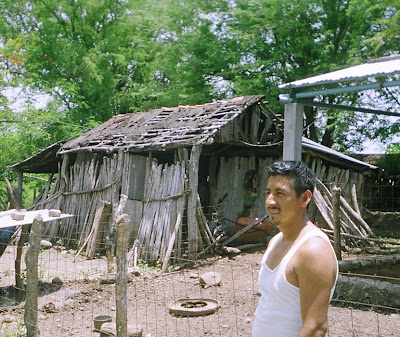
This is the picture of the house they have since built with the money "Abraham" has sent:

Still not much by our standards, with two rooms, and no glass on the windows, but clearly a vast improvement to their previous home. Furthermore, "Abraham's" brother introduced us to "Abraham's" animals, the animals that have been bought with the money he has sent home: goats, pigs, and cows.


They also showed us a full grown mango tree that "Abraham" had planted before he left. We took pictures of all of them and the village and "Abraham's" home to take back to him. They said he would not even know the children under seven, but they would explain to him who was who when they spoke with him on the phone. He does call home periodically, but since they have no phone in their village, he calls someone in the neighboring village. His mother then has to be sent for so that she can come and talk to him on the phone. While we did not meet his father, my friend told me that "Abraham" has been sending money home recently so that his father can buy a truck - his first ever, having only ever had a donkey previously. They were a wonderful family who all gave us hugs as we said goodbye. The little girls picked some of the orange flowers I had admired off a tree and gave them too me. The hardest part of the morning for me was the emotion that filled the face of a mother who had not seen her son in seven years and her incredible gratitude (and his whole family's joy) at having been able to have some contact with some small portion of his life in the States. When we consider the issue of immigration in our country and ponder the teachings of our Church, it helps to have a human face on the issue and to see first hand both the struggles involved for the families of the undocumented, but also the reason they take the risks they take. I share this story and these pictures with you so that we can all ask ourselves, if we were in their situation, what would we do? "Abraham's" family has been able to vastly improve their lives by the mere fact of his making minimum wage at a hotel laundry in the United States. For many of these families immigration (legal or otherwise) isn't a choice, it is a matter of survival.
The friend with whom I was traveling knows a young man, who I am going to call "Abraham" (not his real name, of course, but I will call him after thefounding father of the Judeo-Christian-Islamic tradition who was himself a migrant) in his early 30s who is among the undocumented here from Mexico. "Abraham" works for a hotel in the laundry service in the States. We decided to go and visit his family in Mexico. One of the consequences of the fact that "Abraham" is undocumented is that he has not seen his family in seven years, since he obviously can't return to Mexico to visit on holidays and family occasions. He is from a small "rancho" that we reached by driving on very hilly dirt roads for a good 20-30 minutes (with the help of a local from the nearest city whom we hired to come along with us and give directions; it turned out that the rancho we were looking at is basically made up of one extended family, and he knew of the family and where they lived).
We arrived at a collection of maybe 20 houses (though I use that term rather loosely by our standards), stopping every so often to ask the way to "Abraham's" mother's house. When we arrived, she was a bit leery of who these strangers were, but when we explained who we were and the connection with her son, tears immediately filled her eyes. She was completely overwhelmed to meet someone who had seen the son she had not seen in seven years only days before. She introduced us to "Abraham's" sister-in-law and proudly showed us pictures of his brother's wedding that had taken place last April, but which "Abraham" of course could not attend. She also introduced us to "Abraham's" grandmother who lived across the road. We went to visit the chapel, which was nicer than any of the homes we saw. She was extremely proud of that chapel, though they only celebrate mass there once every one to two months when the priest is able to get out to their rancho.
We then met "Abraham's" aunts, uncle, and cousins. His sister-in-law went to fetch "Abraham's" brother and bring him home from work so that he too could meet us. They brought out wooden benches, and we all sat in the cool shadow of the church while we talked. His cousin told us that her husband, and the father of her four year old daughter, was in Alabama. She had not seen him in two years. They told us they had all been wondering who we were as we drove into the village, asking one another about the car driving through with the "white girl" in it (that was me!). We were the first Americans that had ever been to their village. They went to get a bottle of Coke, which they apparently bought to serve us (though I am not sure where they bought it, as there did not seem to be any type of store anywhere - perhaps from a neighbor?). We speculated later on about their incredible hospitality in desiring to serve us when they clearly had so little themselves. They wanted us to stay for lunch as well, but we refused, saying we needed to be moving on before that.
They took us around the village, including up to the top of a hill that held a brick and cement cistern to gather water, which was then piped down to spigots in the yards (no running water in the houses) of the individual homes. They proudly explained that that cistern contained the water that served the entire village. They showed us the one room school where "Abraham" had been educated until he was old enough to work, after which time he worked during the week and attended school in town on Saturdays. We then returned to "Abraham's" home, where they explained that they had built their new home with money that "Abraham" had sent them from the U.S. This is the house in which "Abraham" grew up:
This is the picture of the house they have since built with the money "Abraham" has sent:
Still not much by our standards, with two rooms, and no glass on the windows, but clearly a vast improvement to their previous home. Furthermore, "Abraham's" brother introduced us to "Abraham's" animals, the animals that have been bought with the money he has sent home: goats, pigs, and cows.


They also showed us a full grown mango tree that "Abraham" had planted before he left. We took pictures of all of them and the village and "Abraham's" home to take back to him. They said he would not even know the children under seven, but they would explain to him who was who when they spoke with him on the phone. He does call home periodically, but since they have no phone in their village, he calls someone in the neighboring village. His mother then has to be sent for so that she can come and talk to him on the phone. While we did not meet his father, my friend told me that "Abraham" has been sending money home recently so that his father can buy a truck - his first ever, having only ever had a donkey previously. They were a wonderful family who all gave us hugs as we said goodbye. The little girls picked some of the orange flowers I had admired off a tree and gave them too me. The hardest part of the morning for me was the emotion that filled the face of a mother who had not seen her son in seven years and her incredible gratitude (and his whole family's joy) at having been able to have some contact with some small portion of his life in the States. When we consider the issue of immigration in our country and ponder the teachings of our Church, it helps to have a human face on the issue and to see first hand both the struggles involved for the families of the undocumented, but also the reason they take the risks they take. I share this story and these pictures with you so that we can all ask ourselves, if we were in their situation, what would we do? "Abraham's" family has been able to vastly improve their lives by the mere fact of his making minimum wage at a hotel laundry in the United States. For many of these families immigration (legal or otherwise) isn't a choice, it is a matter of survival.
Thursday, June 28, 2007
"I praise you for I am wonderfully made" was the response we sang for the Psalm last Sunday. A friend of mine who is a cantor remarked that she found it a bit funny to be singing those words from Psalm 139. We are taught to be so humble, and here it seems as if we are bragging about ourselves! We are wonders though, and we should be aware of and grateful for that fact! Psalm 139 is a well known favorite. This section of it states:
Psalm 139 has been set to music in such well-known hymns as "You Are Near" by Dan Schutte and "O God, You Search Me" by Bernadette Farrell. While both songs emphasize the fact that God created us and knew us in the womb, Farrell picks up this specific line, "For the wonder of who I am, I praise you." I have always loved that line in her song and wonder how often we do stop and thank God for the wonder of who we are. Do we really look at ourselves and marvel at the creation we are? Do we marvel at our role as co-creators with God in choosing the person we become, realizing what an awesome gift and responsibility that is? In many translations of the Bible, this line is translated as "I praise you because I am fearfully and wonderfully made." There is another song that I have always loved by a Christian singer Rich Mullins that picks up this theme. In his song, "We Are Not as Strong as We Think We Are," he sings:
For me, it all comes back to this incredible gift of human life we are given, and how we choose to use it. Are we living the lives that allow us to actualize our full potential as human beings? Are we enabling others to do the same? In moral theology the basic criterion for judging issues is whether or not a certain action or course of action leads to human flourishing. Do our lives enable others to flourish? Are we ourselves flourishing, and if not, is there something we can do to change that fact? We praise God for the wonder of who we are by living our lives in a way that allows us to be the creation God intended us to be! We are only given one life, are we truly appreciating it? There is a great line that I have been reflecting upon lately and will leave you with:
You formed me in my inmost being;
you knit me in my mother's womb.
I praise you, so wonderfully you made me;
wonderful are your works!
My very self you knew;
my bones were not hidden from you,
When I was being made in secret,
fashioned as in the depths of the earth.
-Psalm 139:13-15
We are frail; we are fearfully and wonderfully made.This is one of the things that amazes me about human creation; we seem to be so incredibly strong and so very frail at the same time. We have an unending ability to hurt one another. There is a great vulnerability in being human, and it seems the more human we become, the more vulnerable we are. And yet we have this incredible strength to endure. The song always reminds me that that strength to endure comes from God; that in realizing our dependence on God, we find our strength and our freedom. It is when we try to shoulder the world on our own that we run into trouble. It also reminds me of our need for one another. The irony of life is that we depend on the very people to whom we become the most vulnerable and who have the greatest power to hurt us.
Forged in the fires of human passion,
choking on the fumes of selfish rage.
And with these our hells and our heavens so few inches apart,
we must be awfully small and not as strong as we think we are.
For me, it all comes back to this incredible gift of human life we are given, and how we choose to use it. Are we living the lives that allow us to actualize our full potential as human beings? Are we enabling others to do the same? In moral theology the basic criterion for judging issues is whether or not a certain action or course of action leads to human flourishing. Do our lives enable others to flourish? Are we ourselves flourishing, and if not, is there something we can do to change that fact? We praise God for the wonder of who we are by living our lives in a way that allows us to be the creation God intended us to be! We are only given one life, are we truly appreciating it? There is a great line that I have been reflecting upon lately and will leave you with:
"I gave my life to become the person I am today.
Was it worth it?"
- One, Richard Bach
Subscribe to:
Posts (Atom)

